
What Is Maziwa Mala? And Why You’ve Probably Never Heard of It
Walk into any American grocery store and you will find shelves full of kefir, yogurt, and probiotic drinks. But ask for maziwa mala, and most people will give you blank stares.
That is because Maziwa Mala is not a trendy new superfood. It is an ancient African fermented milk tradition — practiced for generations, but still nearly invisible in Western food culture.
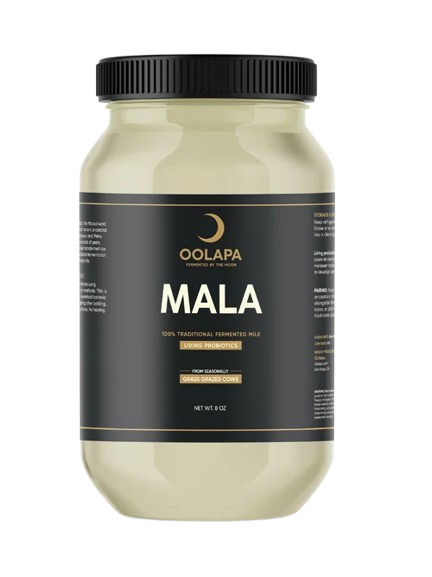
Oolapa Maziwa Mala
A living, traditional African fermented milk made with raw grass-grazed milk, charcoal fermentation, and time.
Maziwa Mala Is an Ancient Fermented Milk, Not a New Trend
Before probiotic drinks became a supermarket category, African communities were already preserving milk through natural fermentation.
Maziwa Mala has been hidden in plain sight. It has lived inside African homes, pastoral communities, family knowledge, and daily food rituals for millennia — but it has rarely been explained to the modern Western food market.
In today’s grocery aisles, people recognize yogurt, kefir, kombucha, and other fermented foods. But Maziwa Mala remains unfamiliar, even though it belongs to one of the oldest and most meaningful fermented dairy traditions in the world.
Maziwa Mala is traditional African fermented milk made through natural transformation: raw milk, time, traditional vessels, and wild fermentation — not modern shortcuts.
The Name: What Does Maziwa Mala Mean?
The name comes from Swahili and says exactly what the food is.
Maziwa
Maziwa means milk.
Mala
Mala means fermented or sour.
Together, Maziwa Mala simply means fermented milk. Simple. Direct. Honest. Exactly what it is.
Across East Africa, fermented milk traditions appear under many names and methods. In Kenya, it includes mursik among the Kalenjin, kule naoto among the Maasai, and iria rimati among the Meru. In Tanzania, communities know similar traditions as mtindi. In Uganda, Banyankole communities call it omuramba. Rwanda and Burundi share ikivuguto, while Ethiopia has fermented milk traditions such as ergo.
The names, vessels, and milk sources may vary — from calabash to clay pot, from cow milk to camel milk — but the principle remains universal: raw milk, time, and natural transformation.
What Makes Maziwa Mala Different?
Maziwa Mala is often compared to yogurt and kefir, but it is not the same. Its process, culture, and flavor are different.
It’s Not Yogurt
- Yogurt usually uses selected commercial bacterial cultures.
- Milk is commonly heated before fermentation.
- The process is controlled and standardized.
- Fermentation often takes hours, not weeks.
It’s Not Kefir
- Kefir is made with kefir grains.
- It uses a symbiotic culture of bacteria and yeast.
- It typically ferments for 12 to 48 hours.
- Its taste and texture are different from Maziwa Mala.
It Is Maziwa Mala
- Raw milk.
- Charcoal fermentation.
- Room temperature transformation.
- No commercial cultures.
- No modern shortcuts.
- Time measured in weeks and months.
The real difference is wild fermentation.
Maziwa Mala is not engineered to taste exactly the same every time. It is a living food shaped by raw milk, environment, beneficial bacteria, traditional knowledge, and time.
The Traditional Method
For thousands of years, African pastoral communities have made fermented milk using gourds, calabashes, or clay pots. Fresh raw milk goes into the vessel. Activated charcoal from specific hardwoods is added during fermentation. Then the milk transforms over days, weeks, or even months.
The charcoal is not just filtration. It is part of the fermentation process itself. It acts as a natural purifier while beneficial bacteria colonize and transform the milk. Once fermentation reaches the desired stage, the charcoal is removed. What remains is pure, living fermented milk.
No one needs to overcomplicate the process with modern language. Traditionally, people know by practice: how it should smell, how it should taste, and when it is ready.
Traditional Process
- Fresh raw milk is collected
- Milk is placed in a traditional vessel
- Activated charcoal is added
- Wild fermentation begins naturally
- The milk transforms slowly over time
- Charcoal is removed before serving
Why You’ve Never Heard of Maziwa Mala
If Maziwa Mala is so old and meaningful, why is it still unfamiliar to most people outside African communities?
It Is Not Easy to Scale
Modern food production wants speed, consistency, and shelf stability. Wild fermentation over weeks does not fit that industrial model.
It Uses Raw Milk Traditions
Traditional fermented milk made from raw milk sits outside the usual pasteurized dairy system, which makes it less visible in mainstream stores.
It Was Passed Down Orally
The technique was taught through observation, family knowledge, and practice — not through mass-market cookbooks or food science textbooks.
It has also been culturally overlooked.
For years, mainstream fermentation culture focused on foods like kimchi, kombucha, sourdough, yogurt, and kefir. African fermented foods rarely received the same attention. But that is changing.
Why Maziwa Mala Matters Now
The modern fermentation revival is finally making space for older, deeper, and more diverse food traditions.
Real Probiotics
People want living foods with diverse natural bacterial ecosystems.
Ancestral Foods
Traditional preparations are being rediscovered for their depth and meaning.
Cultural Authenticity
Consumers want food with real stories, not just ingredient lists.
Living Products
People are seeking foods that feel alive, evolving, and naturally complex.
What Does Maziwa Mala Taste Like?
Maziwa Mala tastes intensely tangy, alive, and complex. If you are used to commercial yogurt, it may surprise you. The longer fermentation creates deeper, more developed flavors, while wild cultures create complexity that single-strain commercial products cannot match.
It is sour, yes — but not unpleasantly so. It is the kind of sour that makes your mouth water. The kind that signals: this is alive, this is real, this has character.
How It Is Traditionally Enjoyed
Many people drink it plain, as their ancestors did, enjoying the pure and unadulterated tang. Others drizzle it with raw honey for a balance of sour and sweet. It can also be served with fermented breads like injera, where double fermentation creates deep flavor harmony.
In pastoral communities, fermented milk has also been consumed with meat — simple, filling, and nutritionally complete.
This Is Just the Beginning
At Oolapa, we are bringing Maziwa Mala to a wider audience — not by modernizing it beyond recognition, but by preserving the traditional method that makes it special.
Oolapa Maziwa Mala is made with raw grass-grazed milk, charcoal fermentation, and time measured in moon cycles. It is for people who want food that feels honest, ancestral, and alive.
This is not a new superfood. It is an old one, finally getting the recognition it deserves.
Ready to Taste Real Maziwa Mala?
Try Oolapa Maziwa Mala and experience traditional African fermented milk made with patience, culture, and living probiotics.
Discover the Fermented Milk Most People Still Don’t Know About
Oolapa Maziwa Mala preserves a traditional African fermentation method with raw grass-grazed milk, charcoal fermentation, living probiotics, and a bold tangy taste.